

The History of the Knuckle Duster: A British Story of Brass, Trenches and Collecting
Few small objects carry a louder history than the knuckle duster. In Britain, its story runs from Victorian prize-fighting halls and police-court reports to the mud of the Western Front and, more recently, to a surprisingly lively community of collectors, EDC enthusiasts and anyone who simply appreciates a well-made piece of metal. This article is a history, not a buying pitch and not a how-to. It is the story of an object that Britain helped invent, argued about, banned — and quietly kept making.
Before we begin, one honest caveat: laws around knuckle dusters differ sharply from country to country, and in the United Kingdom they are strictly controlled. If you are reading this because you collect or are simply curious, the history below will serve you well. If you are reading it for advice on use, you are reading the wrong article.

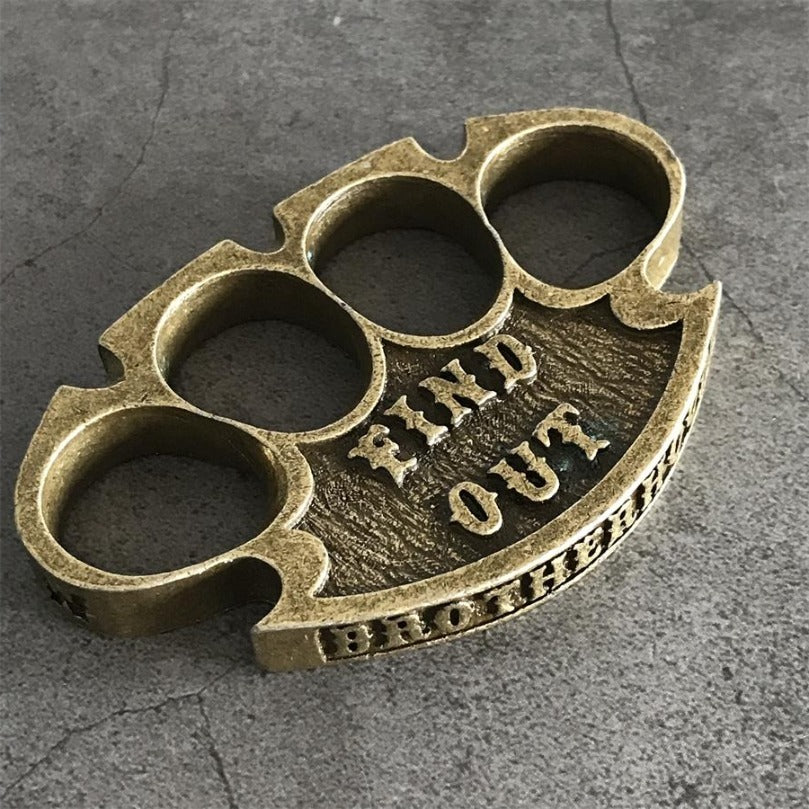
Above: a modern cast-brass piece. The silhouette has barely changed in more than a century and a half.
What Exactly Is a Knuckle Duster?
At its simplest, a knuckle duster is a metal frame that sits across the four fingers, with a curved bar that wraps over the knuckles and a palm rest on the underside. Closed in a fist, it spreads the impact of a blow across a smaller, harder contact area. Most are cast or machined from metal — historically iron and brass, today also steel, aluminium, titanium and zinc alloy.
The defining detail is the finger holes. Four (sometimes two or three) openings make the object feel less like a tool you grip and more like an extension of the hand. That "becomes part of the fist" quality is precisely why the object has fascinated makers, fighters and collectors for so long — and why it has been so consistently argued over.
A note on terminology: "Knuckle duster" is the term that emerged in Britain, and it remains the most common one in Commonwealth English. Americans more often say "brass knuckles." In this article we use "knuckle duster" as the neutral, historical term, and we mean the same object either way.
Britain and the Bare-Knuckle World
The recognisable four-finger metal design is a product of the mid-to-late 19th century, and Britain was at the centre of its origins. The reason has less to do with violence than with a very British institution: bare-knuckle prize-fighting.
For most of the 1800s, boxing in Britain was technically illegal but enormously popular. Fights were held in fields, on riverbanks and in purpose-built halls, watched by audiences that cut across every class — from labourers to aristocrats. The culture around these fights produced a steady demand for small, concealable objects that promised an advantage in a street fight: weighted rings, palm irons, and eventually a frame that fitted over the knuckles themselves.
Several threads converge in Britain at this moment:
- Victorian police-court records. London police reports and Old Bailey case files from the 1860s and 1870s record "knuckle-dusters" being seized in street affrays — among the earliest documentary traces of the object under its modern name.
- Industrial metalworking. Mass-produced cast metal had become cheap. The same foundries that turned out door handles, buckles and harness fittings could turn out a knuckle duster by the dozen, and did.
- Concealable, deniable design. Unlike a knife or a pistol, a knuckle duster drew no attention in a pocket and left no obvious trace until it was already in the fist. That practical anonymity made it attractive and made the police take note of it early.
By the 1880s the object had a name in print on both sides of the Atlantic. The British spelling — "knuckle duster" — stuck, and it is the form the world still mostly uses.
Above: a vintage cast-iron piece. Early examples were rougher and heavier than anything made today.
The Trenches, 1914–1918
If the knuckle duster has a legendary era, it is the First World War — and for British soldiers it became part of the informal kit of the trenches.
Trench warfare was fought at terrifyingly close range. Raids across no-man's-land happened at night, in silence, often with little more than a trench knife or a club. In that world, a small metal object that needed no ammunition, made no noise and could be hidden in a tunic pocket had obvious appeal. Soldiers bent scrap steel, filed down brass and improvised grips; some trench knives were even built with an integrated knuckle bow, and issued or tolerated in limited numbers.
Two things make the trench chapter stick in popular memory:
- Improvised craft. The "trench knuckle" was as much a folk object as a weapon — rough, personal, often unique. Surviving examples are treasured precisely because each one carries the marks of the man who made it.
- The romance of the underdog. In the telling, the knuckle duster became a symbol of the ordinary soldier's grit: a small, personal answer to impersonal industrial warfare.
It is worth being precise. Integrated trench knives with knuckle bows were real, but the loose, pocket-sized duster was more often a personal, unofficial companion than a regulation item. For collectors today, that distinction matters — the genuinely issued pieces are rare and valuable; the improvised ones are stories in metal.
The Knuckle Duster in British Culture
Few objects have moved through British popular culture quite like the knuckle duster. It appears in penny-dreadful fiction, music-hall jokes and crime reporting from the Victorian era onward. Two touchpoints are worth singling out because they are so widely recognised:
- Peaky Blinders. The Birmingham gang culture of the immediate post-war period is remembered — on screen and in local history — for razor-blade caps and, just as memorably, for brass knuckles. The show's version of history is romanticised, but the underlying association of Birmingham, brass and knuckles is not invented. Birmingham was Britain's brass-manufacturing capital, and small metal foundries there could knock out a knuckle duster as easily as a carriage lamp.
- Museum collections. The Imperial War Museum and other British military collections hold knuckle dusters and trench knives from the First World War as historical material — evidence of how central the object was to the ordinary soldier's experience.
The recurring pattern in British culture is the same one found in the history: the knuckle duster is remembered less as a weapon than as a piece of working-class metalwork — made in a hurry, carried in a pocket, and now studied as a document of its time.
Materials and Making: From Cast Brass to CNC
Strip away the folklore and the knuckle duster's evolution is really a story about materials and manufacturing — and brass sits at the heart of it.
Brass is a copper-zinc alloy, and it became the classic knuckle-duster material in Britain for reasons that are almost embarrassingly practical:
- It casts cleanly. Molten brass fills fine detail, which is exactly what you want for a complex shape with four finger holes and a curved knuckle bar.
- It has a satisfying density. Brass is heavy enough to feel substantial without being unwieldy — a quality makers and collectors still prize.
- It develops a patina. Over time brass shifts from bright gold to a deeper, warmer brown. For collectors this is character, not damage — the same reason people love aged leather.
- Britain could make it in quantity. Birmingham and the Midlands were the brass-manufacturing heartland of the 19th century, and the industry that made lamps, taps and buckles made knuckle dusters as a profitable sideline.
| Era | Typical Material | What Changed |
|---|---|---|
| 1860s–1900s | Cast iron, early brass | Hand and short-run casting; rough finishes |
| 1914–1918 | Scrap steel, filed brass | Improvised, rugged, inconsistent |
| Mid-20th century | Polished brass, stamped steel | More uniform production |
| Late 20th century | Aluminium, zinc alloy | Lighter, cheaper, more decorative |
| 2000s–today | Brass, titanium, CNC steel, aluminium | Collector-grade finishes, precise machining |
The modern maker's priorities are different from a century ago. Finish over force, material over menace: buyers today ask about machining quality, patina and edge detailing. The same industries that once served fighting now serve display cases. For those curious about the current cast and machined designs, our brass knuckle collection is a good starting point — pieces chosen for material quality and finish rather than for anything else.
Why the Silhouette Never Changed
Here is a strange fact: in 150 years, the knuckle duster's basic shape has barely moved. Four finger holes, a curved knuckle bar, a palm rest. No other pocket object of comparable age has been so stubbornly consistent.
The explanation is honest and simple: the design is close to its practical limit. Four holes for four fingers, a bar that follows the natural line of a closed fist — there is little room for improvement because the hand does not change. What changed instead was the refinement: from a rough casting to a precisely machined piece you might set on a shelf next to a good pen and a worn pocket knife.
That is also why the design refuses to date. An object built this close to the shape of the human hand does not go out of style; it just gets made better. Four-finger designs, in particular, remain the archetype collectors reach for first.
The Collector's Shelf Today
Today the knuckle duster lives mostly in display cases, on collectors' shelves, and in the pockets of people who appreciate compact, well-made objects. The community around it is far more about appreciation than application:
- Collectibility. Vintage pieces — especially trench-era and ornate Victorian castings — are sought by militaria and curio collectors. Rarity and craftsmanship set the value, not function.
- EDC curiosity. The "everyday carry" hobby treats small objects as design objects. A knuckle duster sits naturally beside pocket tools, coins and mechanical pens: studied for form, material and history.
- Display culture. Social feeds are full of "what's in your case" posts in which a polished brass piece stands alongside a watch and a folding knife — an object that connects the owner to a long, strange lineage of human making.
Curious about adding one to your own display? Our brass knuckle duster selection covers current cast and machined designs, chosen for material quality and finish.
A Note on Responsibility
Any honest history ends with the law. Knuckle dusters are classified as offensive weapons under UK law and are strictly controlled — what is legal to own is not always legal to carry, and restrictions differ sharply around the world. Reputable collectors treat the object as a historical and design piece, research their local regulations, and make their decisions accordingly. This article is about the object's past and craft — not guidance on use. Check local laws before purchase.
Frequently Asked Questions
Q: When was the knuckle duster invented? A: The recognisable four-finger metal design emerged in the mid-to-late 19th century, and the name "knuckle duster" appears in British police-court reporting of the 1860s and 1870s. It is a product of industrial metalworking and prize-fighting culture — not ancient warfare.
Q: Is "knuckle duster" a British term? A: Yes. The spelling and phrase emerged in Britain and remains standard in Commonwealth English; Americans more commonly say "brass knuckles." Both refer to the same object.
Q: Were knuckle dusters used in the First World War? A: Informally, yes. British and other soldiers in the trenches carried homemade and scavenged knuckle weapons because they were small, silent and needed no ammunition. Trench knives with integrated knuckle bows were also issued or tolerated, but the loose pocket duster was mostly a personal, unofficial item.
Q: Why is brass the classic material? A: Brass casts cleanly into fine detail, has a satisfying density in the hand, and develops a warm patina that collectors value as character. Britain's 19th-century brass industry — centred on Birmingham — also made the material the obvious choice.
Q: Are knuckle dusters legal in the UK? A: They are classified as offensive weapons and are strictly controlled. The legal position differs by country, and "legal to own" is not always "legal to carry." Always check your local regulations before purchase.
Q: Are knuckle dusters still made? A: Yes. Modern makers produce them in brass, steel, aluminium, titanium and zinc alloy, aimed largely at collectors and EDC enthusiasts who value material, finish and design.
Q: What is EDC, and why are knuckle dusters part of it? A: EDC (everyday carry) is the hobby of carrying a small set of useful, well-made objects daily. Knuckle dusters fit as compact design pieces studied for material and history, alongside pens, coins and pocket tools.
Written by the Knuckleduster team — a small independent shop that researches the history and craft behind the pieces we carry, so collectors can buy with context rather than just curiosity.
Keep reading: our guide to brass knuckles — and what to look for in a well-made piece.